

Recent dump.



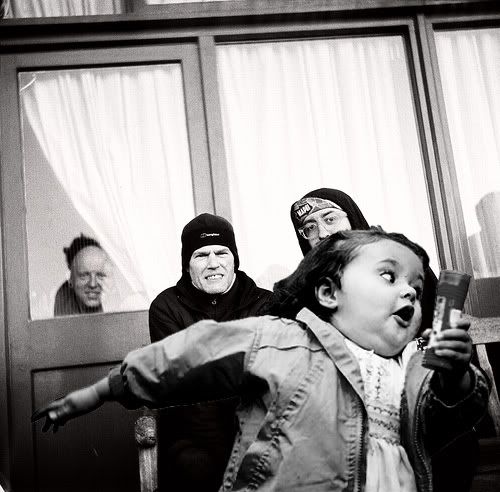


A very interesting bit of Tumblr drama played itself out to all of those who follow Mogadonia. Recently, it was discovered that Lovegifs had been posting animated gifs without re-blogging or posting any credit, a number of which came from Mogadonia (including some original creations), and therefore unleashing his/her(?) wrath. Mogadonia has put everything together in one tidy post, though a good number of posts were made on the subject.
For those who haven't got Tumblr accounts, beyond just being a public blog, Tumblr acts as an image/post sharing community, where users can "follow" each other and thus build an expansive and continuously updated stream of material on their "dashboard". One feature that comes in really handy is the ability to "re-blog" at the click of a button. This will automatically create a kind of "quoted" blog post (that you can edit) with a digital mark that saves info like who was the original poster, who liked the post, and who re-blogged the post.
This in itself is quite good at maintaining a kind of posting integrity, where even if you choose to strip the post of back-links and previous poster comments, there will always be a link to the original poster that can be accessed by other Tumblr users.
To make things even more interesting, a new feature called the "Tumblarity" was recently added to the dashboard. From the Tumblr staff blog:
[...] we’ve been using an internal metric called “Tumblarity” to sort and filter content on the Search and Popular Content pages. Tumblarity is derived from every blog’s activity and popularity across our network.


The term dates back to the mid-1980s. Because BBSs were often accessed by a single phone line (frequently in someone's home), there was an expectation that all who used a bulletin board would contribute to its content by uploading files and posting comments. Lurkers were viewed negatively, and might be barred from access by the sysop, if they did not contribute anything but kept the phone line tied up for extended periods.So my first question is, can the blogosphere be lurked? Although Web 2.0 has helped transform (the concept of) the internet into a participatory rather than merely informative platform, beyond the ability to comment (which not all authors choose to allow), the blog offers a purely one way relationship to its audience. And like an audience, blog readers are usually faceless or nameless, there are no (or at least rarely) lists of active users at the bottom of the page. Which brings up the third issue, which is, can lurkers be compared to an audience?


Dragan Espenschied quote:Non-art Sites:
From: Gravity
"The pressure to be up to date with technology appears insane to me. It doesn't bring any more beauty or pleasure. Instead it creates things that are hard to understand and impossible to handle. So nobody can actually experience them beyond reading the artist's concept."
(quite rich considering that it comes from Rhizome) ([eta] I'm mocking Rhizome, not Dragan Espenschied)
Tom Moody Quote:
“Artists, too, have to compete with real world content far more captivating than anything they could come up with, which the Internet effectively gathers all in one place (sneezing Pandas, etc). Two possible responses are (1) to continually rise above it through aesthetic and conceptual framing and posturing or (2) to disappear into it and trust the viewer to ultimately sort out what's going on. The Web is a consumer's medium, not a producer's, so the artist is inexorably led to consumption as a "practice." The degree of criticality can only be inferred, not implied."
 Class 2Class 3Class 5Class 6
I find everyone's work to be more alive in the surf club, probably because even though a surf club is still a controlled context, it seems truer to the web than most pristinely designed individual artists' sites. I also noticed that surf clubs don't function that differently than the traditional artists' exhibiting collectives that we like so much here. Unmoderated by curators, and a variety of other gatekeepers and the artists end up driving it themselves, to mixed results, but when it's good, it's very good.Marisa Olsen on Surf Clubs:
Class 7Class 9Class 101. As a place where artists promote their “real world” work.
The site acts as a slide sheet and resume for self promotion. [in case you haven't noticed, this is most definitely NOT what this class is about, you don't take a printmaking course to print exhibition invitations, or an art history course to write up your own C/V]
2. The site acts like a more traditional "white space" gallery.
Harwood - Mongrel Tate, http://gallery9.walkerart.org/, http://www.sfmoma.org/espace/espace_overview.html
3. Where the art starts offline but there is a web component that's important to reach the intended audience.
http://www.critical-art.net/ http://www.safetygearforsmallanimals.com/SGSA.html
4. where artist use the medium itself to mess with the ideas of what the internet should be.
http://www.exonemo.com/ http://www.jodi.org/. http://map.jodi.org/
5. where artists use social networking / web 2.0 tools and the culture of digital society itself as a medium for making art.
Tom moody, Double Happiness, Loshadka, nasty nets
6. People who never intended to make art, but it has "become" art over time, or some of us artists consider it art. [Joe is some of us]
All Your Base, Fensler Films
Class 11Class 12Class 14Think about how you use your white-space (backgrounds).
Class 16Class 17Class 18Class 19Class 20Class 21Artists and writers—and our advocates, our guilds and agents—too often subscribe to implicit claims of originality that do injury to these truths. And we too often, as hucksters and bean counters in the tiny enterprises of our selves, act to spite the gift portion of our privileged roles. People live differently who treat a portion of their wealth as a gift. If we devalue and obscure the gift-economy function of our art practices, we turn our works into nothing more than advertisements for themselves. We may console ourselves that our lust for subsidiary rights in virtual perpetuity is some heroic counter to rapacious corporate interests. But the truth is that with artists pulling on one side and corporations pulling on the other, the loser is the collective public imagination from which we were nourished in the first place, and whose existence as the ultimate repository of our offerings makes the work worth doing in the first place.
Class 22Class 23Class 24 (last class)
 Posts
All Comments
Posts
All Comments