Showing posts with label Musing. Show all posts

Sunday, 3 April 2011


Srsly, who fucking says that?

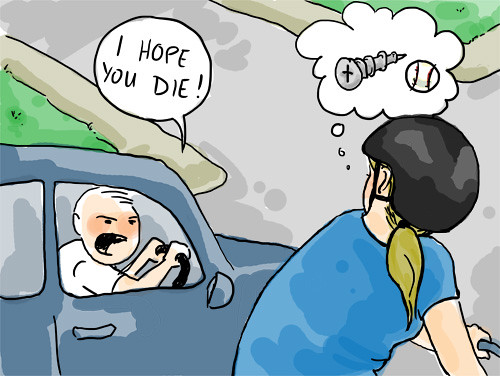
I'm not usually so easily offended, but it really insults me when people in cars wish death upon cyclists.

Yesterday, as a few of us came to an intersection and a few were riding more casually than I guess this dude liked. I, unfortunately, waited at the intersection for the lights to change (while others went through) only to get a barrage of insults. At first he was muttering the insults to himself but loud enough to be heard and then decided to shout out "I hope you die". I looked back all confused and replied quizzically "I hope you die too?" WTF?! Total wanker!

A few months ago some dude tweeted something similar and got totally abused. Rightly so. He wished bodily harm to cyclists that choose not to stay in the gutter (ie. the bike lane). This is an absurd sentiment, considering cyclists are often safest when furthest away from the curb where they can actually be seen, but it seems to be quite common: Stay out of my sight, and I won't run you down. Some contract.

Monday, 3 January 2011

Goodbye, Year of the GIF


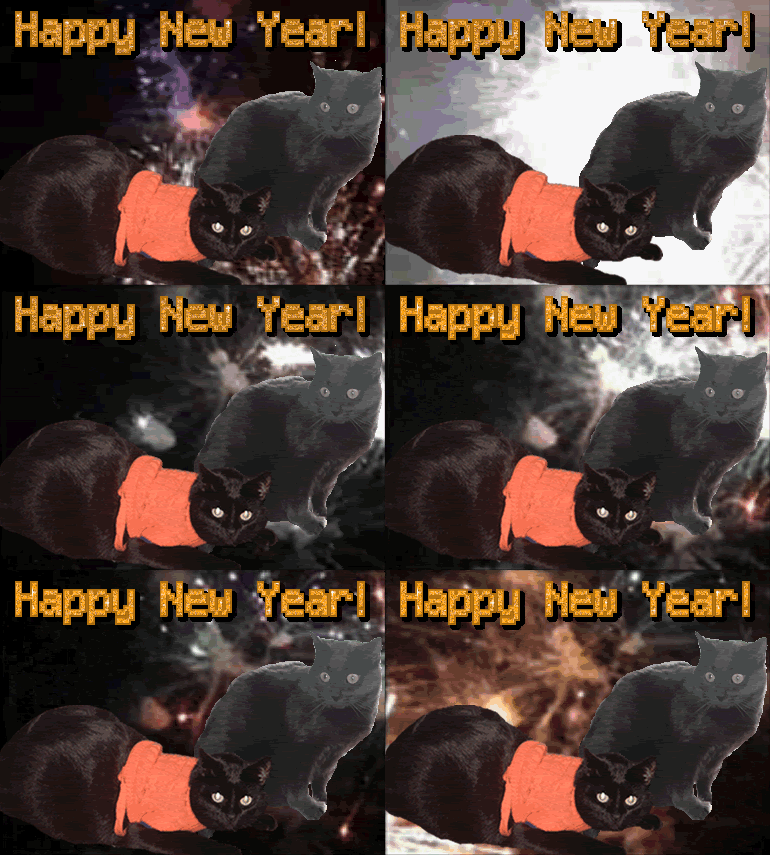
I made this GIF* two years ago to bring in 2009. I felt very positive about the new year having spent the last 6 or so months discovering animated gifs and net based art. The following New Year, I was completely inactive, being almost midway into a 6 month hiatus where I didn't post here or image dump on tumblr, and pretty much kept myself in the dark on the subject. Little did I know, I was missing the first half of the year of the animated gif.

Luckily, I did keep lightly in touch thanks to a few favorite blogs via Google Reader and noticed that dump.fm was getting quite a lot of attention from Tom Moody. I kind of wrote it off as another Tumblr (which I quickly realised wasn't exactly true), and a couple initial visits to the site didn't really encourage me - which can be the case for many first time visitors - as it can be a bit difficult as a newcomer to interject in what feels like a private party. What finally got me excited was the (brief) digital pog renaissance (currently immortalised on one of dump's "pages"). I made a couple new pogs in excitement, sad that I missed the dump session itself.


The feature I enjoyed most (but which no longer exists) was the calendar of themes/assignments. They set it up so that everyday, or most days, a theme would be thrown out there to work from, which would then result in a page like the pog page listed above. It was a great way to get the ball rolling and focus the brainstorming (I'm a subscriber to the idea that limitation breeds innovation). It also made it a lot easier to join in on the conversation, but I digress ...

Tumblr and dump.fm helped bring a new gif based aesthetic into the mainstream, expanding from the insider/web-only context to art exhibitions around the globe, articles in mainstream press (online and off), and even a few music videos directed by favorite gif artists. Although the animated gif as a format may not translate well outside of the browser, it's the look that appears to be making the outroads. I'll be interested to see what happens in the new year.

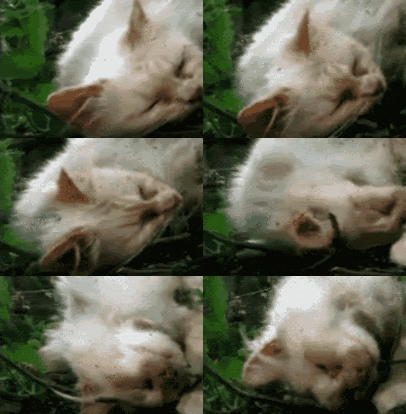
* On a gloomier side note, I thought about the above GIF because, yeah, it's another new year, but also because Horatio (the grey one) passed away on Christmas Eve. She was Mark and my first cat and was the sweetest, loveliest cat. She wasn't without problems, she had a chronic health problem that was often quite distressing - for her and us - but her passing (due to cancer) was very sudden and very very sad (she was only 8). RIP Horatio, you were the best!

Monday, 20 December 2010

"Casual GIF Theory"

Been thinking about GIFs lately with all the recent articles (trying to get my thoughts in order before trying to express them). Seems to be happening to others as well. Namely, Tom Moody's discussion with John Michael Boling on the subtleties of the animated GIF, which has been missing in mainstream writing.

Is this the advent of GIF theory?

Thursday, 2 December 2010

Dreaming About Real Life


I had a weird dream this morning about dump.

I was visiting home in Toronto and heard of a dump gathering in New York and decided to come along as it was (relatively) close by. The meet was not so much a social gathering but an internet cafe (or more like a school computer lab) full of dumpers dumping. You could get up and chat, or use a headset to join in live voice chat.

For some reason, I made myself a wig and beard (including uni-brow) out of pine needles. I took the brow and beard off pretty early on, though (it was very uncomfortable), and kept the wig.

I did end up chatting to a couple dumpers, mostly idle chit chat, nothing particularly interesting, and I can't remember what it was about. I finally took my "wig" off towards the end of the conversation — I showed it off, it was nice and soft, like a fleece cap.

There doesn't seem to be any point to it, but it was very vivid and the image of the pine face wig really stuck with me.

With all the recent IRL manifestations of dump — recent exhibitions, projects by other dumpers, and even a Secret Santa — participation (or lack thereof) has been at the forefront of my mind.

The internet allows for (a level of) anonymity and, with that, a lack of responsibility. Bringing it into real life takes away that security.

Could this dream just be an expression of my social-media-anxiety?

Wednesday, 17 November 2010

Spiritual Internet: Dump Altars


Tom Moody, 2010

I think the above dump is the closest to a definition of what a dump altar is. Basically a triptych (or more-tych) which combines a central image propped up by peripheral pillars that will act to emphasise the central image as an object of worship (usually ironic) or will play with the central image to create a visual pun or joke (or at least, that's how I interpret it).

To give you an idea just how popular it is as a dump format, take a look at http://dump.fm/altars/ which is updated any time a combo is dumped that follows the format.

I haven't dumped many altars during my sporadic visits to the site, I tend to go for the single image posts or duos - http://dump.fm/lalblog/altars

(post written after a reminder brought to you by Tom Moody's recent interview about animated gifs and dump)

Saturday, 9 October 2010

New Age Default: Dump.fm Weekend

dump

So I went to the dump.fm weekend opening last night at New Gallery London in Camberwell. The exhibition is one part of the short series New Age Default curated by Ben Vickers.

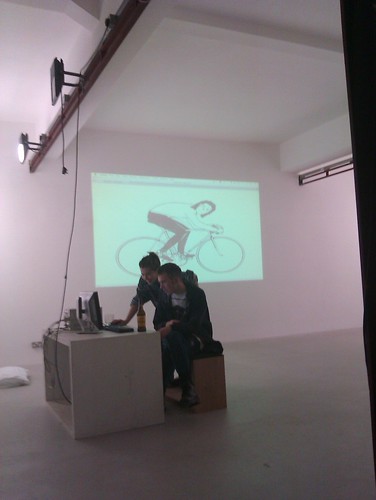
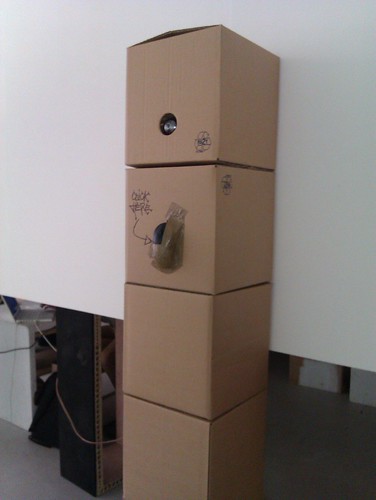
I was curious to see how the exhibition was going to be laid out, because how do you exhibit a live chat stream slash image dump? I guess Ryder saved everybody that problem with dump fullscreen, and it was pretty nice to see a bunch of random supersized gifs projected on the wall, though you do miss out on the multi-image combos. In addition, there were two computers signed in as NuGallery1 and NuGallery2 for in-gallery anonymous dumping, an image dumping webcam known as DumpBooth and a hotdog under a pillow (part of a series called Adding to the Internet by Justin Kemp)


(left: folks enjoying dump, right: DumpBooth)

It was kind of interesting dumping in a different environment. I usually have a hard time keeping my concentration up while dumping because it usually happens at night after having worked all day. When you consider how low your attention span needs to be* to keep up with the incessant chat and imagery - not to mention the fact that I'm sitting on a lumpy couch with a slow laptop burning my legs while I do this - you might not be able to keep your energy levels up for very long, so brighter lights, louder music, cold beer and a bunch of hipsters leaping in front of a webcam behind you can made for some exciting (anonymous) dumping.

* [EDIT] This sounds really derogatory, but I mean it in the most positive way. TV and the internet are always accused of lowering people's attention spans, but I think that's what makes everybody capable of taking in so much information at once. I'm just saying that I'm not fast enough for dump.


(left: dump by jeeeelings, right: dump by noisia)

It was good to see dump being exhibited. Mostly because it's only exhibit-able as an interactive piece (art gallery as internet cafe) and so doesn't lose what makes dump so amazing, but also because, for some reason, internet based work and new media just isn't that popular in London. It's been going gangbusters in New York, Toronto, and even Berlin, but doesn't have the audience here. I briefly chatted with Ben, and he's got a bunch of plans in the works to help change that, so I'll try and keep in the loop to support any future projects (and by support, I mean go to).

Tuesday, 31 August 2010

Another day sick, Another day browsing.

I came across this exhibition idea I had that I haven't thought about for a while. I shared it in the comments of the (now abandoned) group blog we set up for the MA collaborative project over a year ago now:
I’ve had this fantasy exhibition in mind for a little while now: a small gallery packed with ceramic objects on white plinths – so close together that when viewers come to maneuver through the gallery they can’t help but brush up against, and ultimately knock over, the unstable and highly breakable objects. There would be no security to “prevent” people from touching things, and big bags would be more than welcome within the space. The only problem I can see, though (beyond the fact that people would catch on to the “joke” if the exhibition went on for more than a day), would be with health and safety.
I'm sure there could be a really elaborate rational about boundaries, expectations and the preciousness of art, but I just thought it was funny.

Sunday, 8 August 2010

Revisiting the "sub-amateur"

Tom Moody made a few comments after my post on the sub-amateur where he gets a bit more into the actual nitty gritty of what it means to introduce and apply a term like "sub-amateur" (and doing so across disciplines, which doesn't always work). The term is indeed somewhat unnecessary — especially with net art where the internet acts not only as inspiration, medium and platform, but also as distributor and equalizer — and, as Moody pointed out, it does confuse (or at least needlessly complicate) the simplification brought about by Duncan Alexander's text.

I have to admit, as someone who floats along the surface, I'm often misinterpreting and getting confused on the topic, which isn't helped by my tendency to re-appropriate ideas and terms in ways that work for me. "Sub-amateur" got me excited because that's where I saw myself - as somebody who isn't an artist and who doesn't want to be taken seriously, but has a bit of a background and just wants to explore, discover and maybe even create.

Basically, net art is my hobby, and I get the impression that this is true for a lot of people (though I'm sure nobody would snub a gallery or group exhibition invite), and though we are not "serious" (chilling for the sake of chilling), we do still engage, develop interesting ideas and, in turn, produce quite a lot of stuff. It could be therefore reasonable to be considered as a "category" (maybe a sub-category of the amateur?) within the net art "scene." Because, although the work might not be produced as "serious work," it is still worth looking at and at times even contemplating seriously. However, because it was never really intended to be a "work of art" per se, you will find a different, perhaps more casual (I'm tempted to say disinterested, but the term is too loaded to throw around so, erm, casually), approach to subject matter. What that different "attitude" or approach is, I have no idea, and maybe I'm needlessly picking at the fly shit, but that's only because I'm in no way qualified to get into it.

Friday, 30 July 2010

Surf Camp: An Amateur-ish Essay on the Sub-Amateur

Photobucket

There's been a bit of discussion taking place recently about the two camps of net art, where the "insider" and "outsider" sit within these camps, and how chill time plays a role within this construct.

Duncan Alexander's categories are (briefly):
Camp 1 which is more caught up in the art historical context. "The net is their vehicle for dissemination, and they stand out from the online flow. Rarely do these works link outside of themselves; if hypertext is involved, it is internal to the site."

Camp 2 which bases itself more within the "net historical" context. "What matters in camp two's work - or what is emphasized by the artists - is not so much the individual artwork as the artist's oeuvre and net presence."
So camp 1's work tends to be a bit tighter, and can stand on its own as art when presented "outside" of the net. Whereas camp 2's work thrives in the net context, and often loses meaning or relevance once removed from it's place of inception, which tends to usually be the surf club, tumblr or dump.fm (that's not to say these works won't be presented outside of their natural environment, though they'll usually be accompanied by a link back to let you "in" on the joke).

In the comments, Tom Moody likens Alexander's camp 2 to what others have termed as the "amateur and sub-amateur". The amateur is self taught, they create for the love of the craft or art and, motivated by this love, will develop their skills and technical know-how to better express their vision. The sub-amateur is also self taught, but to a point. They are more interested in the subject matter and therefore will often resort to (if not seek out)"defaults", or pre-determined settings found in the instrument or programme of choice.

Here is Gutherie Lonergan's handy table differentiating between the "Hacker" and "Default" approaches to net art to break up the text.


This all seems to suggest that the current string of net art all falls under the "amateur" tag, which I think is only because the "pro" group is still being groomed, if they aren't already emerging from the art school new media and computer art BFAs and MFAs that have been popping up over the last 5 or more years (my alma mater started a computer art course in 2006/7, before I even had a clue). In either case, we still have amateurs that are well entrenched in the art world, with many art school trained artists repeatedly popping up in gallery based animated gif exhibitions throughout the world. So, moving back to the beginning, the amateur is in no way the outsider when it comes to the artworld.

But what about the sub-amateur's relationship to the established artworld? What about those surfing dudes and dudettes that make shitty (not meant as a derogatory term) gifs and take part in the online chatter but don't exhibit, or plan to exhibit, beyond their own tumblr blogs? The actual "slackers of the art world"?

The jstchillin manifesto, to me, seems to imply the leisure aspect of net art. Both the amateur and sub-amateur take "chill time", but where one will draw from their chill time to produce work, the other chills for the sake of chilling. You could even go as far as saying that the sub-amateur are the ultimate decadents, consuming copious amounts of digital tat without giving any "thing" back beyond online in-jokes that are usually ugly and hard to look at; they are the virtual leisure class (this such a generalization and total contradiction, but I'm saying it anyway because it's dramatic and sounds cool).

The sub-amateur could be seen as the outsider for remaining outside of the gallery and focusing not on the product but on the act of chilling itself, and perhaps they are. As Moody put it:
[...] the term outsider sounds cruel and judgmental and snobby but all it means is "one who makes art heedless of a context larger than one's own computer (or studio, or computer/studio)."
But the sub-amateur is too self aware - of their activity as an aesthetic act and of their position in the history of (net) art - to be the outsider. In fact, the tendency to function as a collective also places them deep within an inside that is constructed by themselves: you had to have been there to understand why I put this seemingly random face on this other seemingly random body and captioned it with this bit of nonsensical text, but trust me it's terribly clever and funny as fuck.

The unique thing about chill time, though, is that, unlike most other leisure activities (I'm going to ignore the possible can of worms that is craft), there are plenty of byproducts and documentation that come out of it, which are the blog posts, collections, mash-ups, and even archived discussion. Even if the product isn't the point, it will still spread around the internet as people try to latch on to it by reblogging or further deconstructing the information to make something new. Authorship can definitely become an issue, and if you're that interested in the credit you can rest assured that infamy and an audience can still follow. Alternatively, you can also just sit back, chill and revel in the satisfaction of seeing something you didn't put that much effort into make the rounds across the net or, better yet, go viral.
Tuesday, 29 September 2009

Bandwidth Exceeded


Never thought I'd see the day that my stupid photobucket account would run out of bandwidth. I blame the lolcat posts I made ages ago and have decided to delete them. There are enough of those damn cats floating around to not need mine, dammit!

Thursday, 17 September 2009


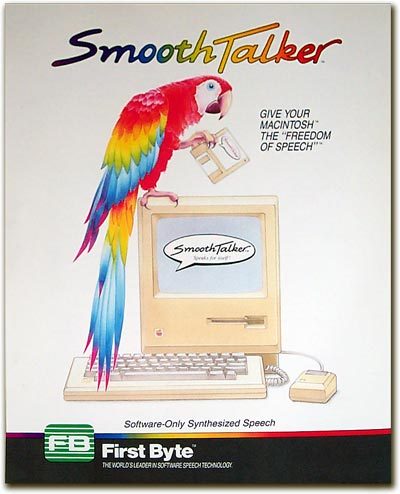
Things I like about this image: The chance to give your computer "Freedom of Speech".

Although the potential of giving my computer freedom of speech makes me feel morally superior as enlightened liberator, I'd rather not give my computer any actual individual rights fearing a robotic uprising. Instead, I'll let it think it has "freedom" and only have it repeat my commands ... like a parrot.

(via pootee.tumblr)

Wednesday, 1 July 2009

Tumblr Dramr, or How Tumblarity Made Tumblr Less Good


A very interesting bit of Tumblr drama played itself out to all of those who follow Mogadonia. Recently, it was discovered that Lovegifs had been posting animated gifs without re-blogging or posting any credit, a number of which came from Mogadonia (including some original creations), and therefore unleashing his/her(?) wrath. Mogadonia has put everything together in one tidy post, though a good number of posts were made on the subject.

For those who haven't got Tumblr accounts, beyond just being a public blog, Tumblr acts as an image/post sharing community, where users can "follow" each other and thus build an expansive and continuously updated stream of material on their "dashboard". One feature that comes in really handy is the ability to "re-blog" at the click of a button. This will automatically create a kind of "quoted" blog post (that you can edit) with a digital mark that saves info like who was the original poster, who liked the post, and who re-blogged the post.

This in itself is quite good at maintaining a kind of posting integrity, where even if you choose to strip the post of back-links and previous poster comments, there will always be a link to the original poster that can be accessed by other Tumblr users.

To make things even more interesting, a new feature called the "Tumblarity" was recently added to the dashboard. From the Tumblr staff blog:

[...] we’ve been using an internal metric called “Tumblarity” to sort and filter content on the Search and Popular Content pages. Tumblarity is derived from every blog’s activity and popularity across our network.

Tumblarity is a popularity guauge that only the user themselves can see (unless they decide to publish it, and many have boasted about it) and seems to be calculated by a combination of stats that include number of posts per day, number of likes, number of re-posts and who knows what else (Tumblr doesn't actually lay out what makes up the number).

The number can fluctuate like mad, and originally had users posting about their confusion, which was probably even more confusing for "outside" readers. Initial reviews were mixed at best (there's a great one on Gawker that puts it best IMO), but the topic has more or less faded from the collective Tumblr conscious. It does, however, manage to tacitly resurface from time to time when issues such as this one come about.

Though Tumblarity may have nothing to do with Mogadonia's frustrations, having it there to remind you of how "successful" your work, taste and curatorial skills are makes "credit" that much more important. It's no longer just a matter of properly citing your sources, but also of giving "props", and though I empathise and respect an artist's copyright, I can't help but feel that a lot of this is based more in the ego trip of popularity.

I am by no means above this, I always revel when my "finds" get re-blogged or posted elsewhere, linking back to either here or my Tumblog, but one can't justifiably force themselves upon others by saying "I made this!" or "I found this!" when so little (especially when it comes to animated gifs) is ever found only once or by only one person. Part of the joy of the internet is the anonymity and reproducibility - success is when a gif spreads like a virus and can no longer be traced to an "original" (what and where is the original when it comes to digital material, anyway?) - it is no longer "mine" but of the internet.

Perhaps I'm being too idealistic, but what is represented as conspiracy looks to me like a show of laziness and/or a desire to have (yet another) hot new animated gif Tumblog. Lovegifs is little more than a minor symptom of the internet and, at worst, a major symptom of Tumblarity.

Friday, 6 March 2009

Is this real life?

I just finished going over this post on Double Happiness, and then went to BBC news to see this:


(click for bigger version)

I don't know what is reality anymore.

Wednesday, 25 February 2009

Lurkers v Audience


I just read a kind of interesting blog post linked via the NN delicious network on Lurking as Community. Basically, it's trying to take a positive spin on the lurker, which I don't mind, since I am one - always have, always will be. It suggests that the lurker can still have an impact on the community, which I don't doubt, but I just don't necessarily agree with the examples chosen. For one, the author is using a specific individual that she knows is a lurker but also knows as a RL contributor to that community. The next problem I have is that the network she specifically refers to is the blogosphere.

Lurking, as I understand it, refers to individuals who are visibly present within an interactive platform and still choose not to participate (or, more specifically, contribute, because in visibly being there they are participating by leaving a mark). Message boards are a perfect example as they are nothing but user created material and the members and guests that are viewing the forum are always listed somewhere at the bottom of the screen ("I see you lurkin'!). I like the history of the term given on Wikipedia:
The term dates back to the mid-1980s. Because BBSs were often accessed by a single phone line (frequently in someone's home), there was an expectation that all who used a bulletin board would contribute to its content by uploading files and posting comments. Lurkers were viewed negatively, and might be barred from access by the sysop, if they did not contribute anything but kept the phone line tied up for extended periods.
So my first question is, can the blogosphere be lurked? Although Web 2.0 has helped transform (the concept of) the internet into a participatory rather than merely informative platform, beyond the ability to comment (which not all authors choose to allow), the blog offers a purely one way relationship to its audience. And like an audience, blog readers are usually faceless or nameless, there are no (or at least rarely) lists of active users at the bottom of the page. Which brings up the third issue, which is, can lurkers be compared to an audience?

Audiences, unless to a participatory event, are not expected to contribute, and the instant they begin to take part, the boundaries between audience and actor begin to break down (which is the point of most participatory events). A lurker, I would say, is more like a student. In class, you are often expected to participate, but many choose to say nothing. They are taking in the information (or not) and will fulfill their requirements elsewhere.

The lurker, it is understood, is "taking up space," they are that person standing in the way when everybody around them is trying to get on. I don't want to put such a negative spin on it, but I'm just trying to contrast the lurker with the audience for whom a space to "lurk" or observe has been assigned: An audience has a place to stand or sit, whereas a lurker is right in the thick of it.

Lurkers participate within their community because of their visibility. We are aware of their presence not just because they are observing the actions of others, but because we are also anticipating their possible activity. They are potential. And because we don't know what they'll say, or when they'll say it, because they are not behaving in the expected way, they can bring about some form of anxiety in the others, making the lurker hyper visible.

Friday, 16 January 2009

Fraud!


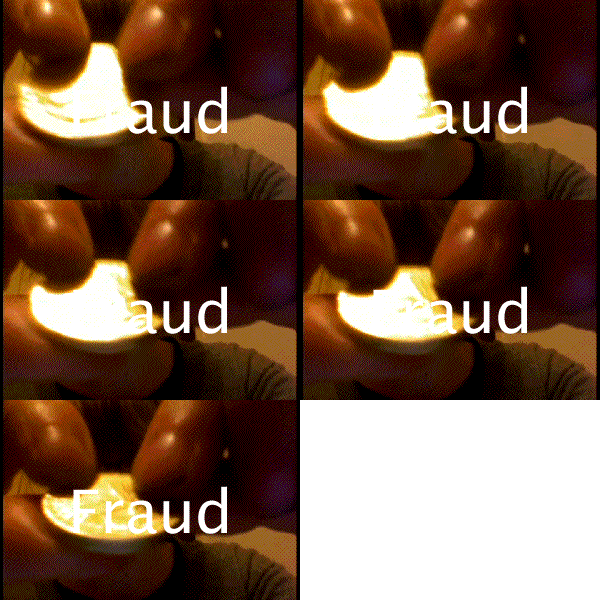
I received a counterfeit pound coin the other day. They've become a lot more common lately and, prompted by the failing economy, brought about a small media frenzy last September, making us not only aware of their existence but also able to recognize the difference.

The thing with fake coins isn't so much about them being fake, but a problem of recognition. If nobody noticed, it wouldn't be a problem, it's when you browse through your pocket change and notice that the two faces of the coin don't line up right or that the cross on the side of the coin isn't fully detailed that the problems begin. You're either down a pound or, if you try to use it and can't feign ignorance, you're a fraud!

Sunday, 30 November 2008

Artists with Computers

A really interesting post by Tom Moody looking at the differences between "new media" artists and "artists with computers" in the context of a previous post on "art photography" and "artists with cameras":
[...]

The latter care about their laptops as much as Cindy Sherman cared about her camera. Necessary mechanical skills can be learned but the habits accompanying those skills need to be unlearned. Also, artists may not always and at all times be "with computers"--it's a tool to be picked up and put down as needed.

New media suggests a respect for hardware & software and belief in their newness, something artists with computers don't care about. New media involves a finicky devotion to programming and process, whereas artists with computers are bulls in the Apple Shop. New media artists tend to germinate in design or media arts programs whereas artists with computers incline to studio arts backgrounds or autodidacticism.

[...]
I'm wondering, though, if maybe the distinction has a bit to do with how seriously one takes the medium, or whether or not the medium is pushed to the point that it becomes the subject of the work. If this is the case, is the reason why "new media" artists have so much difficulty with "artists with computers" because the artists don't pay enough respect to the technology? Are "artists with computers" just "new media" noobs?

Saturday, 8 November 2008

Digital Pog Bloggin' - Not so Old Skool after all!

A heads up was given to me by Tom Moody about Michael Bell-Smith's inclusion of his Digital Pog page during his presentation at the Montage: Unmonumental Online talk which took place early this year. Coincidentally, only a couple days ago, Rhizome put up the entire panel discussion on Vimeo - I'm reposting Michael's talk here.


It was nice to see him get a little more into his rationale behind this project, as there isn't that much on his pog page (it doesn't really have to be, but it's interesting): the parts about the pogs being not really for game play, but as collectible aesthetic "objects;" their "web-ring"-like function that brings various people interested in web art together, introducing them to other artists and individuals that are making interesting things and that they may never have seen otherwise.

I don't know much about the psychology of collection, but there is always something attractive about the collectible and pleasurable about the display of collections - huge pieces of furniture have been designed for ages simply for the display of collectibles, and I'm sure many people remember how Web 1.0 homepages were often littered with sprites depicting various things, characters, etc. (which also, incidentally, served as a link advertising your own homepage).

I think the interesting thing, though, is how it brings this practice to the "art" level or to "art" status. So amongst all the image bookmarking sites (which in effect are art collections), one can still have small images that can easily - and intentionally - be collected and displayed online; one could go along collecting tens of Naruto avatars, or collect works of art by actual artists (though the feat of the former will never go unappreciated). But it's not even as serious as that - they're fun, creative, original, clever ...

Hmmm ... to be continued, I think.

Saturday, 1 November 2008

Old Skool! - Some Digital Pog Bloggin'


Two years has never seemed so long as it has since delving into the world of web art. Something that was new and exciting two years ago is now old hat, passé - been there ... DONE that - but at least it means that, for a "noob," there's lots of stuff to uncover and rediscover. Among those things, for me at least, is the Digital Pog - a creative digital version of the collectible game (Pogs) that I had the joy of experience during their heyday in the early to mid nineties (yeah, I had my own crappy collection too). The idea came about in 2006 by Michael Bell-Smith, who's comprehensive collection of Digital Pogs (along with the official template for creating your own) still exists, showcasing some works by (web) artists such as Tom Moody, Sally Mckay, John Michael Boling, Matt Smear, Daniel Szymanowski, and Michael Bell-Smith himself (all of whom I've quoted above in that order).

The format brings about several interesting problems and challenges: as an artistic format that "limits" the artist, and as a game that can't technically be played in the same way as the RL game of Pog. Tom Moody stirred up some interesting discussions about the format through his "Pog Bloggin.'" His first post, Digital Pog Criticism (aka "pog bloggin'"), gives a nice run-down of the POG's origins along with a few points of criticism comparing the Digital Pog to the avatar format, acknowledging it's role within the digital gift economy (which is even more interesting now considering how many online communities and networking sites sell digital icons in limited editions to be exchanged or given as gifts online, which seems counter intuitive when considering the nature of a digital image as an unlimited edition), and exploring the potential difficulty that can be had working with the inconveniently round shape of the pog (which can also act as a great point of inspiration).

It's in his post more digital pog blogging, though, that the discussion gets interesting: how can one create a feasible solution to the problem of game play, which is the intended way for players to collected new Pogs? Technically, I have absolutely no idea how to go about it without stripping away the openness of Digital Pog creation. One would have to create an app with registered users in order to play fairly, but it would also have to allow for pog creation that would be powerful enough to allow individuals the freedom to create the pogs they want to create. At which point, the open source-ness of the Digital Pog begins to be lost.

Unfortunately, it would appear that the success of the Digital Pog stayed only with it's potential as a collectible art form, and as a result, the artists making (and I suppose collecting) seemed to have lost interest - Digital Pogs have, more or less, disapeared from our sights. Being new to the format, however, I still find it pretty interesting, and have created a small number of GIFs bellow (the last one is a pog-ified version of this sweet GIF I made). So yeah people, lets bring it back! (until I'm bored with it too)

Friday, 10 October 2008

"New Internationalism" and the Information Aesthetic

Throughout the year, my programme offers guest lectures by various artists and academics that deal with contemporary art practice and thought. Yesterday we had our first visiting lecturer, Neil Mulholland. He introduced himself with this Powerpoint presentation he made originally for a panel discussion at the Frieze Art Fair 2005 on New Internationalism which asked:
Does the rapid development of new art centres encourage greater cultural diversity, or has it resulted in a new international orthodoxy? How can discourse keep up with information?
This was his response:


The context he presented it in for yesterday's talk, however, was not New Internationalism, but for the potential of Art Writing as an alternative to traditional criticism and art historical texts. He argued that Art Writing, as a mise-en-scène, can offer information and criticism without necessarily being mimetic, allowing for greater freedom in the act of writing.

In this context the video (the format we're seeing it in now - as Powerpoint it embodies the tone of the presentation a lot more authentically) is not only an ironic answer to the panel's question, but an exploration of language as well. This typically American style of corporate speak or legalese is used to poke fun at the corporatisation of contemporary art through art fairs and biennales (it also reflects artspeak's own obtuseness) but also looks to it as a new development in language with its own value and merit. It's a linguistic turn with a similar aesthetic value as the images he chose to illustrate his presentation, and one that reminded me a lot of the image bookmarking and surf club scenes.

I guess you could say it's the information aesthetic, but a kind of nostalgic information aesthetic - one that hearkens back to a more innocent time when artificial visual and linguistic representations of utopia had a nice plastic, almost Orwellian, quality, and computers were a pleasant shade of pale taupe.